



Objectives
AiRisk pursues the following objectives: (i) characterisation of contaminated dust from piglet farms and investigation of dust as a vector for antibiotic-resistant and/or zoonotic bacteria (WP1 & 2), (ii) translation of laboratory and field trial results into a dispersion model (WP3) to enable risk assessment for humans and the environment, (iii) communicating these risks to decision-makers and the public (WP5) and (iv) implementing intervention measures such as disinfection methods (WP4) to provide professionals with a basis for responding to biological hazards. The findings from AiRisk will be disseminated to stakeholders, policy-makers and public health services (WP6).
By integrating expertise from the fields of public health, veterinary medicine and environmental medicine within a One Health approach and linking this to emergency response, AiRisk will provide key tools and strategies to prevent outbreaks and ensure a coordinated and effective response in the event of an outbreak. This approach will ultimately strengthen the capacity of the relevant sectors to manage and mitigate the risks associated with antimicrobial resistance and zoonotic pathogens.
Projects
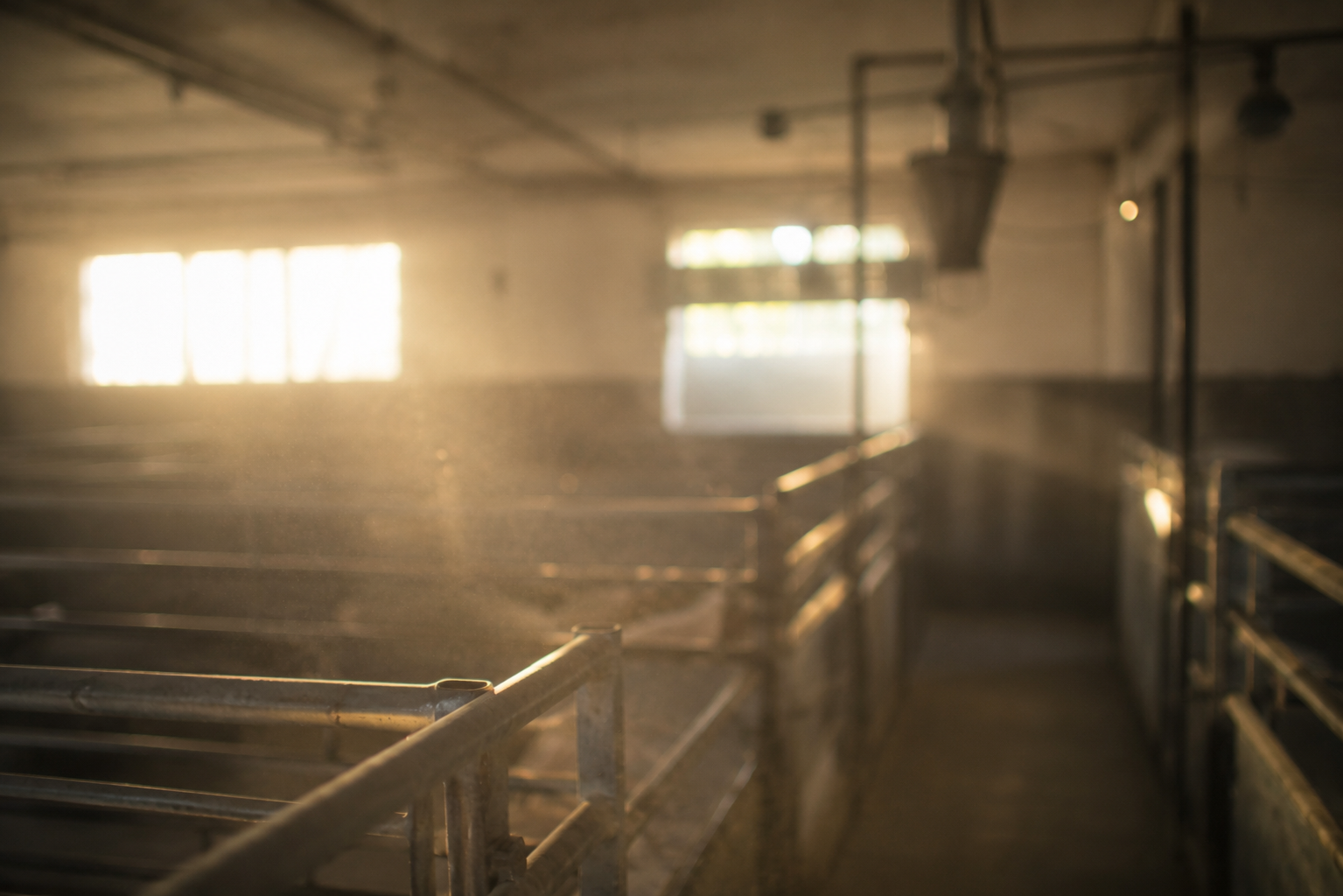
Bioaerosols within and in the immediate vicinity of pig barns will be investigated. Thereby, various aspects of dust particles are characterised, including their concentration, size distribution, hygroscopicity and morphology. These properties are crucial for understanding the behaviour of bioaerosols in the air and their potential impacts on the environment and health. A comprehensive analysis of the microbial composition is carried out using modern next-generation sequencing technologies to identify microbial communities and potentially harmful organisms. In addition, the toxic and immunogenic activities of the dust are investigated to determine the extent to which the particles may pose health risks to animals and humans.
The investigation of the persistence of dust-bound bacteria in the air, on water and on barn surfaces depends largely on the respective environmental conditions. The ability of the bacteria to form biofilms on dust particles is also analysed in detail. These biofilms can promote the survival of the bacteria under unfavourable conditions and increase their resistance to disinfectants and other stress factors. Another focus of the research is on understanding the development of antibiotic resistance in bacteria, which is influenced by various environmental stressors. These findings are important for better understanding the spread of antibiotic-resistant bacteria and for developing targeted countermeasures.
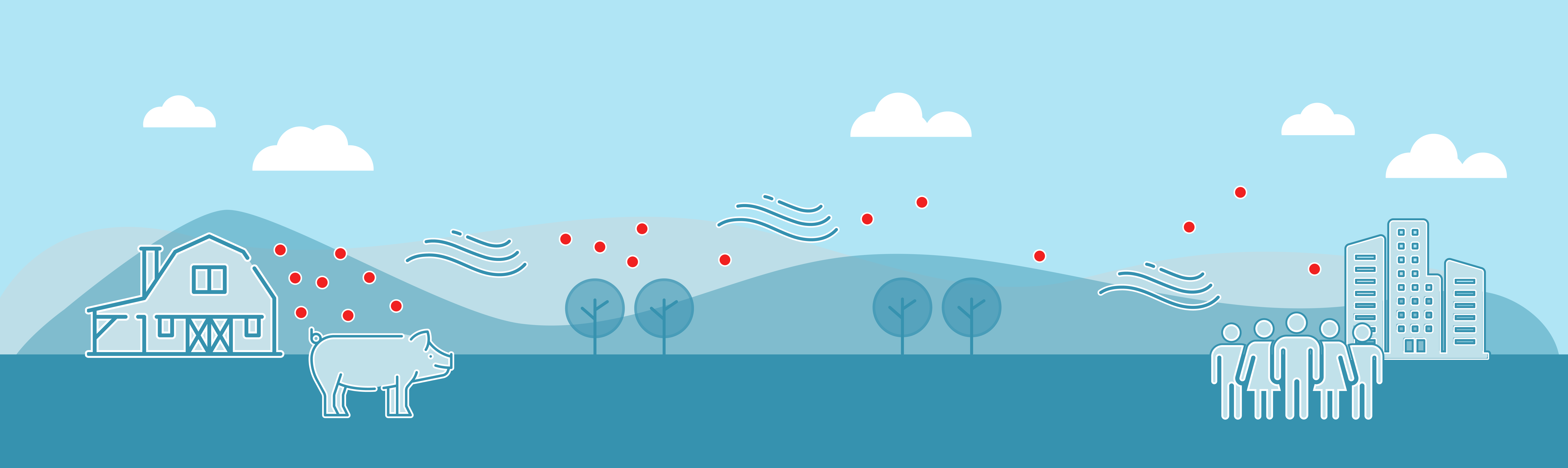
Dust aerosol particles may consist of soil particles from agricultural land, plant residues from crops, or animal feed. Soil dust particles can be entrained into the atmosphere through wind erosion or mechanical soil cultivation. This is presumably the predominant emission mechanism; however, air inside livestock housing may also become enriched with dust aerosol particles, which are then released into the surrounding atmosphere via barn ventilation systems. Due to their origin, aerosol particles may carry pathogens that pose a risk to both animals and humans.
The use of numerical models is well suited for the systematic investigation of airborne dispersion pathways as a function of emission scenarios (agricultural land, livestock buildings) and meteorological conditions (e.g., weather patterns). In this way, both different sources of aerosol particles (agricultural land and livestock buildings) as well as dispersion pathways and the distances traveled can be analysed. At the same time, meteorological variables describing the state of the atmosphere can be used to determine the exposure of aerosol particles and any potentially attached pathogens to atmospheric conditions.
Since atmospheric environmental conditions (e.g., UV exposure, temperature, humidity) can reduce the viability of pathogens, the residence time and dispersion pathway in the atmosphere are critical factors in assessing a potential contamination risk. Furthermore, model simulations can be used to determine the deposition areas of aerosol particles depending on the emission scenario and meteorological conditions
This work package evaluates various intervention measures. Research into various options and strategies for the safe and reliable disinfection of surfaces plays a central role in the fight against the spread of diseases. The study examines which methods are most effective for cleaning potentially contaminated surfaces and preventing the spread of pathogens. In addition to disinfection during normal operations, procedures that can be used in the event of an incident are also to be evaluated.
In addition, the project aims to develop a conceptual framework for an integrated set of recommendations that brings together approaches, structures and tools for improved monitoring and assessment of airborne AMR transmission processes within a One Health context.
During the course of the project, recommendations for validated and harmonisable metrics as well as methodological approaches to aerosol surveillance in the relevant sectors will be developed, with a focus on assessing public health risks. Particular emphasis will be placed on developing a basis for a potential governance and process map that defines clear responsibilities and communication channels. At the same time, formats and recommendations will be developed that enable scientific findings to be translated into practice-oriented courses of action, particularly for stakeholders such as policymakers, public administration and the public health service (ÖGD).
Thus, this work package not only establishes a scientific basis for the further development of AMR surveillance, but also serves as a key driver for the transformation towards an integrated, prevention-oriented and resource-efficient strategy for AMR surveillance at the national level.
The work package “Risk and Crisis Communication Framework for a One Health Approach” has the overarching goal of making a significant contribution to improving prevention and effective response in the context of infection control. It addresses the funding policy objectives of the German Federal Government’s “Future Strategy for Research and Innovation” (Mission III) as well as the Sustainable Development Goals (SDG 3) by promoting trans- and interdisciplinary collaboration among relevant disciplines and promoting networking in the field of infectious disease research.
The focus of this work package is on developing a sustainable and agile communication framework for risk and crisis communication. This framework takes into account both the public’s perspective and organizational efforts toward pandemic prevention. The goal is to facilitate effective communication among various stakeholders, ranging from public health surveillance authorities and decision-makers to the general public. The aim is to develop effective prevention strategies and response mechanisms and to improve preparedness for future health crises.
To this end, an integrated communication management system will be designed, tested using hypothetical scenarios, and optimized to ensure its flexibility and practicality. The results of the work package will be documented in a comprehensive manual detailing the communication structure. This will serve as a guide for all stakeholders, facilitating communication with practitioners and the public. Through close collaboration with the RKI and the THW the network of infectious disease research is strengthened and makes a significant contribution to the implementation of the One Health approach.
The practical application of the results from WP 1–5 is central to AiRisk. The THW bears primary responsibility for this. The exchange between research and practice is to be strengthened, particularly with a view to future outbreaks of infectious diseases. To this end, the THW works closely with scientists and partners in the field of public health. The THW focuses in particular on the question of how new scientific findings can be communicated to stakeholders and emergency responders in disaster and civil protection, and—in close collaboration with the consortium partners—identifies the best methods for doing so.
Bioaerosols within and in the immediate vicinity of pig barns will be investigated. Thereby, various aspects of dust particles are characterised, including their concentration, size distribution, hygroscopicity and morphology. These properties are crucial for understanding the behaviour of bioaerosols in the air and their potential impacts on the environment and health. A comprehensive analysis of the microbial composition is carried out using modern next-generation sequencing technologies to identify microbial communities and potentially harmful organisms. In addition, the toxic and immunogenic activities of the dust are investigated to determine the extent to which the particles may pose health risks to animals and humans.
The investigation of the persistence of dust-bound bacteria in the air, on water and on barn surfaces depends largely on the respective environmental conditions. The ability of the bacteria to form biofilms on dust particles is also analysed in detail. These biofilms can promote the survival of the bacteria under unfavourable conditions and increase their resistance to disinfectants and other stress factors. Another focus of the research is on understanding the development of antibiotic resistance in bacteria, which is influenced by various environmental stressors. These findings are important for better understanding the spread of antibiotic-resistant bacteria and for developing targeted countermeasures.
Dust aerosol particles may consist of soil particles from agricultural land, plant residues from crops, or animal feed. Soil dust particles can be entrained into the atmosphere through wind erosion or mechanical soil cultivation. This is presumably the predominant emission mechanism; however, air inside livestock housing may also become enriched with dust aerosol particles, which are then released into the surrounding atmosphere via barn ventilation systems. Due to their origin, aerosol particles may carry pathogens that pose a risk to both animals and humans.
The use of numerical models is well suited for the systematic investigation of airborne dispersion pathways as a function of emission scenarios (agricultural land, livestock buildings) and meteorological conditions (e.g., weather patterns). In this way, both different sources of aerosol particles (agricultural land and livestock buildings) as well as dispersion pathways and the distances traveled can be analysed. At the same time, meteorological variables describing the state of the atmosphere can be used to determine the exposure of aerosol particles and any potentially attached pathogens to atmospheric conditions.
Since atmospheric environmental conditions (e.g., UV exposure, temperature, humidity) can reduce the viability of pathogens, the residence time and dispersion pathway in the atmosphere are critical factors in assessing a potential contamination risk. Furthermore, model simulations can be used to determine the deposition areas of aerosol particles depending on the emission scenario and meteorological conditions
This work package evaluates various intervention measures. Research into various options and strategies for the safe and reliable disinfection of surfaces plays a central role in the fight against the spread of diseases. The study examines which methods are most effective for cleaning potentially contaminated surfaces and preventing the spread of pathogens. In addition to disinfection during normal operations, procedures that can be used in the event of an incident are also to be evaluated.
In addition, the project aims to develop a conceptual framework for an integrated set of recommendations that brings together approaches, structures and tools for improved monitoring and assessment of airborne AMR transmission processes within a One Health context.
During the course of the project, recommendations for validated and harmonisable metrics as well as methodological approaches to aerosol surveillance in the relevant sectors will be developed, with a focus on assessing public health risks. Particular emphasis will be placed on developing a basis for a potential governance and process map that defines clear responsibilities and communication channels. At the same time, formats and recommendations will be developed that enable scientific findings to be translated into practice-oriented courses of action, particularly for stakeholders such as policymakers, public administration and the public health service (ÖGD).
Thus, this work package not only establishes a scientific basis for the further development of AMR surveillance, but also serves as a key driver for the transformation towards an integrated, prevention-oriented and resource-efficient strategy for AMR surveillance at the national level.
The work package “Risk and Crisis Communication Framework for a One Health Approach” has the overarching goal of making a significant contribution to improving prevention and effective response in the context of infection control. It addresses the funding policy objectives of the German Federal Government’s “Future Strategy for Research and Innovation” (Mission III) as well as the Sustainable Development Goals (SDG 3) by promoting trans- and interdisciplinary collaboration among relevant disciplines and promoting networking in the field of infectious disease research.
The focus of this work package is on developing a sustainable and agile communication framework for risk and crisis communication. This framework takes into account both the public’s perspective and organizational efforts toward pandemic prevention. The goal is to facilitate effective communication among various stakeholders, ranging from public health surveillance authorities and decision-makers to the general public. The aim is to develop effective prevention strategies and response mechanisms and to improve preparedness for future health crises.
To this end, an integrated communication management system will be designed, tested using hypothetical scenarios, and optimized to ensure its flexibility and practicality. The results of the work package will be documented in a comprehensive manual detailing the communication structure. This will serve as a guide for all stakeholders, facilitating communication with practitioners and the public. Through close collaboration with the RKI and the THW the network of infectious disease research is strengthened and makes a significant contribution to the implementation of the One Health approach.
The practical application of the results from WP 1–5 is central to AiRisk. The THW bears primary responsibility for this. The exchange between research and practice is to be strengthened, particularly with a view to future outbreaks of infectious diseases. To this end, the THW works closely with scientists and partners in the field of public health. The THW focuses in particular on the question of how new scientific findings can be communicated to stakeholders and emergency responders in disaster and civil protection, and—in close collaboration with the consortium partners—identifies the best methods for doing so.